Sarcura
Sarcura set out to tackle one of the toughest challenges in advanced medicine: how to manufacture cell therapies at scale. With an interdisciplinary founders team and a research-derived, innovative product for a growing market, they aimed to miniaturize and automate cell therapy production on a chip.
At xista science ventures, we are proud to have supported this journey from its early days, providing capital, infrastructure, and a place in our community. While Sarcura will not continue as a company, it's achievements and people remain part of our ecosystem as a Retired Innovation Pioneer. This is the reality of science-driven entrepreneurship: not every venture reaches the market, but each one advances the frontier for those who follow.
Solving existing bottlenecks for cell therapy manufacturing
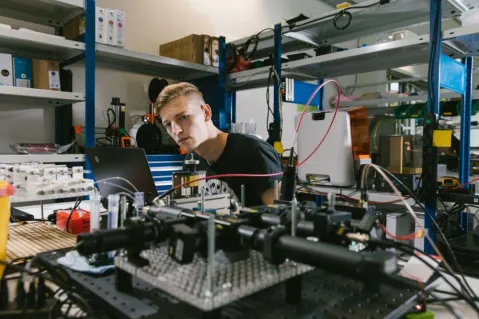
However, current CGT manufacturing is burdened by time and labor intensive open, manual processes, uncontrolled unit operations, high lot-to-lot variability and manual documentation requirements, leading to manufacturing costs of up to several hundred thousand dollars per dose.difficult to scale. Sarcura’s bold vision was to merge semiconductor, photonics, and bioengineering to miniaturize and automate these workflows, essentially turning complex labs into intelligent, chip-based systems. This on-chip functionality enables process management, real-time analytics and quality control on a cellular level, combined in modular functionality incorporated in a closed single-use cartridge.
Founded in 2019 by Daniela Buchmayr together with cell biology expert Erwin Gorjup and microfluidics specialist Martin Fischlechner, the company uses technology that allows the integration of electronic and photonic structures on silicon substrates. depth and capital intensity it would require. Between 2021 and 2023, the team made strong progress: developing functional prototypes, validating key technologies, and initiating a collaboration with IMEC in Belgium. However, the next step, building a scalable system close to market application, would have required over €20 million in additional funding.
In today’s economic climate, where growth capital for DeepTech has dropped sharply, the risk-reward profile of the project no longer aligned with market realities. The decision to end Sarcura was not made lightly, but with clarity, based on data, timing, and the future scalability of the approach.
Our investment rationale
At xista science venture, we backed this mission early on, fully aware of the technical depth and capital intensity it would require. We decided to invest as Sarcura combines an interdisciplinary founders team with a research-derived, innovative product for a growing market with a strong need.
“Sarcura has been an ideal example of what a high-risk, high-potential DeepTech venture can look like. t was a bold bet, one we entered with eyes wide open. Daniela and her team made remarkable progress in a technically complex and clinically relevant field. And just as it takes vision to build something like Sarcura, it also takes clarity and maturity to know when to pause.
What we take with us: DeepTech ventures of this caliber need capital models that reflect their complexity, resilience in key roles, and frameworks that support long and non-linear development paths. The team delivered key insights, working prototypes, and a technological roadmap that still points toward the future. That matters and we’re deeply grateful for their trust, determination, and relentless curiosity.", says Florian Resch, xista science ventures case manager.
A Personal Reflection from Daniela Buchmayr, Founder & CEO of Sarcura
“We started Sarcura to solve a problem that’s only getting more urgent. Cell therapies work, but the way we manufacture them is fundamentally unscalable. Even if cost weren’t an issue, you couldn’t produce them for every patient. You’d need thousands of cleanrooms and armies of skilled operators and still wouldn’t achieve consistent quality. That’s not a system; that’s a bottleneck.
Our vision was to change that: to build an autonomous manufacturing platform inspired by the semiconductor industry where biology meets precision engineering. Shrinking entire labs into chips. Bringing analytics, control systems, and automation into a closed capsule. No operators. Just a smart machine, optimized for cell therapy production.
We knew from the start this would be capital-intensive and technically hard. But we also knew it was necessary. And with early support from xista and others, we proved the concept and laid the foundation.
What changed wasn’t the need it was the economic climate. Raising over €20 million for a long-term DeepTech project became incompatible with the market’s current appetite for fast returns and minimal risk. Timing matters. In our case, we were just slightly ahead of it.
If I were to do it again, I’d design it differently: with strategic partners from day one, more structural buffer in the team, and a funding model tailored to long-cycle innovation. But I don’t regret a thing. I still believe in this technology. And I still believe that we need people who build, even when the odds are against them.
My hope is that we create an ecosystem where high-risk, high-impact ventures have the time, resources, and room to grow. That investors are supported and incentivized to stay in the game beyond the typical cycle. Sarcura may not have reached the market, but it added real value. To the field, to the network, and to what comes next.”
XISTA Team